NuDrive: The Operating System for Industrial Autonomy
Why the next era of freight autonomy will be won in the real world
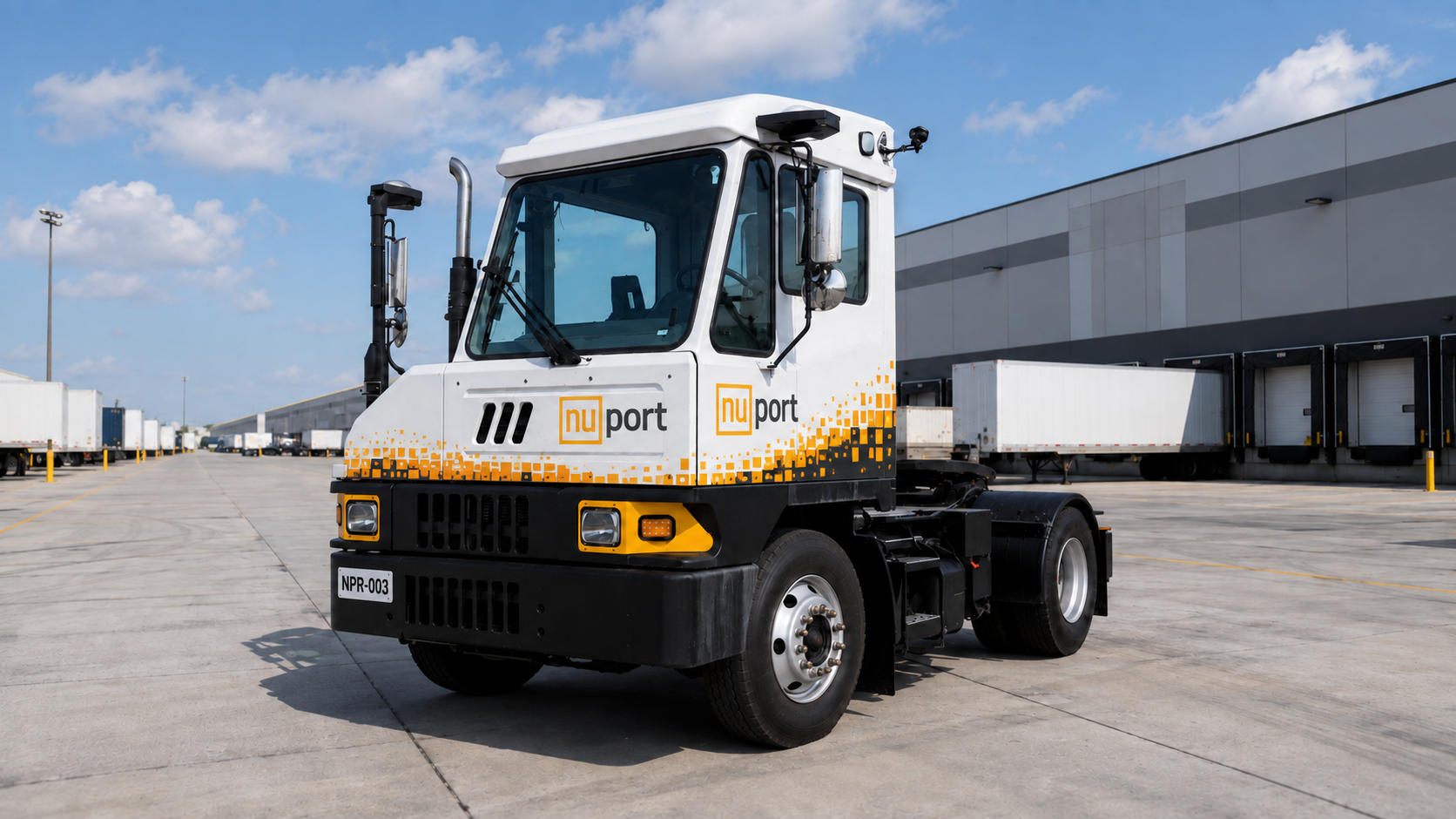
Billions of dollars went into foundational AI research, custom sensor stacks, HD mapping and simulation over the last decade. Dozens of companies shared one bet: whoever built the best driving intelligence first would own the future of transportation.
That era produced real technological progress, and it ran into a wall. Building an autonomous system that performs on a sunny, well-mapped test route is one problem. Deploying it into a live industrial operation, where the yard is full, the weather has turned and the schedule does not pause, is another.
Advances in edge compute, neural architectures and AI foundation models have since compressed development timelines. Capabilities that took first-generation programs most of a decade are now reached in a fraction of the time, and the barrier to building autonomy is falling fast.
The barrier to operationalizing it has not moved. That gap is what NuDrive was built to close.
Industrial autonomy is more than self-driving
The phrase "self-driving truck" understates the job. Moving a vehicle from one point to another without a driver in the cab is a necessary capability. On its own, it does not run a freight operation.
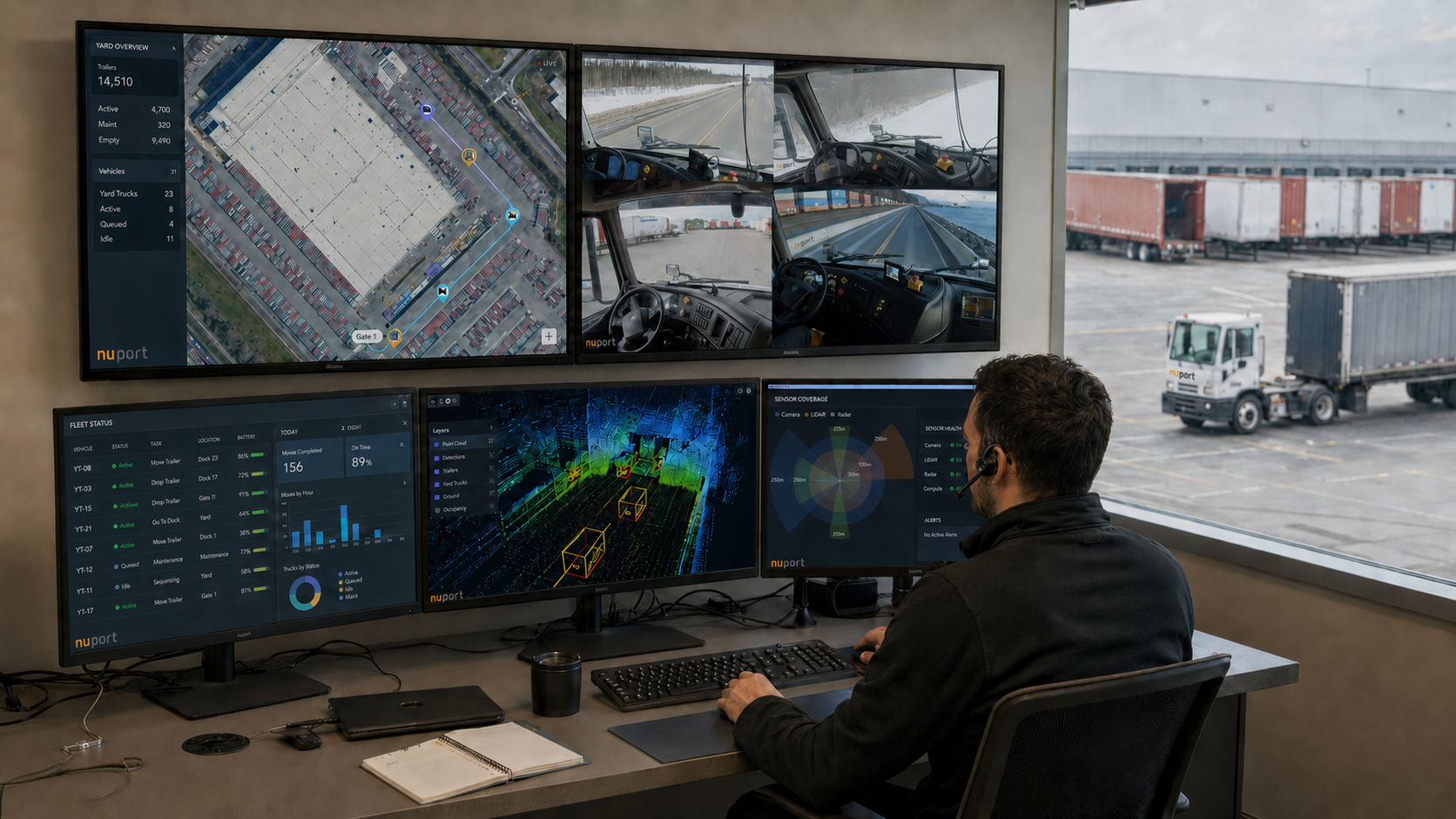
Deployed inside a working site, an autonomous vehicle has to take work from a dispatch system and coordinate with other vehicles and with people on foot. It has to integrate with the terminal operating system already in place and report its status to the people accountable for that site. It has to hand control to a remote operator when something falls outside its envelope, and it has to do all of this across a full shift without becoming one more thing the yard has to manage.
Operators buy predictable outcomes, and they measure them the way they measure everything else on site: uptime, throughput, safety record, cost per move.
Introducing NuDrive™
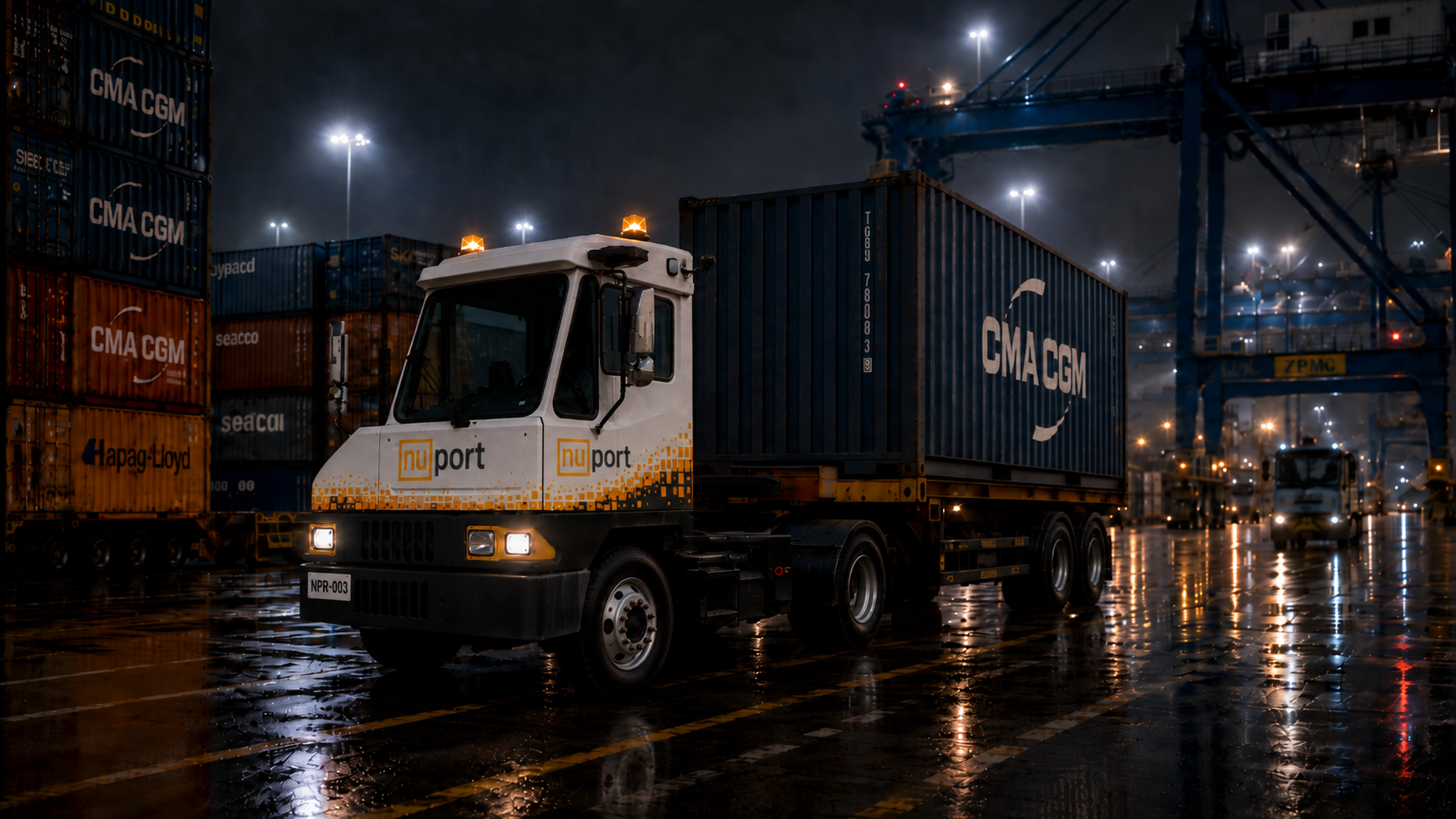
NuDrive is NuPort's AI operating system for industrial autonomy. It brings the full autonomy stack, from perception through fleet orchestration and remote oversight, into a single layer designed to run on the fleets operators already own.
NuDrive was built as a platform from the start. The same core is designed to operate across Class 8 trucks, terminal tractors and other industrial vehicles, and across the workflows they serve: yard moves, terminal transfers, inspection routes and industrial logistics.
The long-term vision is simple.
Every vehicle. Every workflow. One autonomy OS.
Physical AI is changing the economics of autonomy
Physical AI is where artificial intelligence stops working only with information and starts perceiving, reasoning and acting in the physical world. For NuPort, that world is roads, yards, distribution centres, ports, terminals, mines and forestry sites, and the vehicles moving freight through them.
The economics of building in that world have shifted. An autonomy program once required thousands of engineers, bespoke hardware and years of brute-force iteration. Teams can now build on mature foundation models and modern robotics AI infrastructure. NuPort applies these advances so that a vehicle can interpret what is happening around it and not only move through it, drawing on generative world models, reinforcement learning and multi-agent behaviour modelling for sites where vehicles, equipment and people are all in motion at once.
That progress is available to the whole sector, which is why a misconception is taking hold: lower barriers to building autonomy are being read as lower barriers to deploying it.
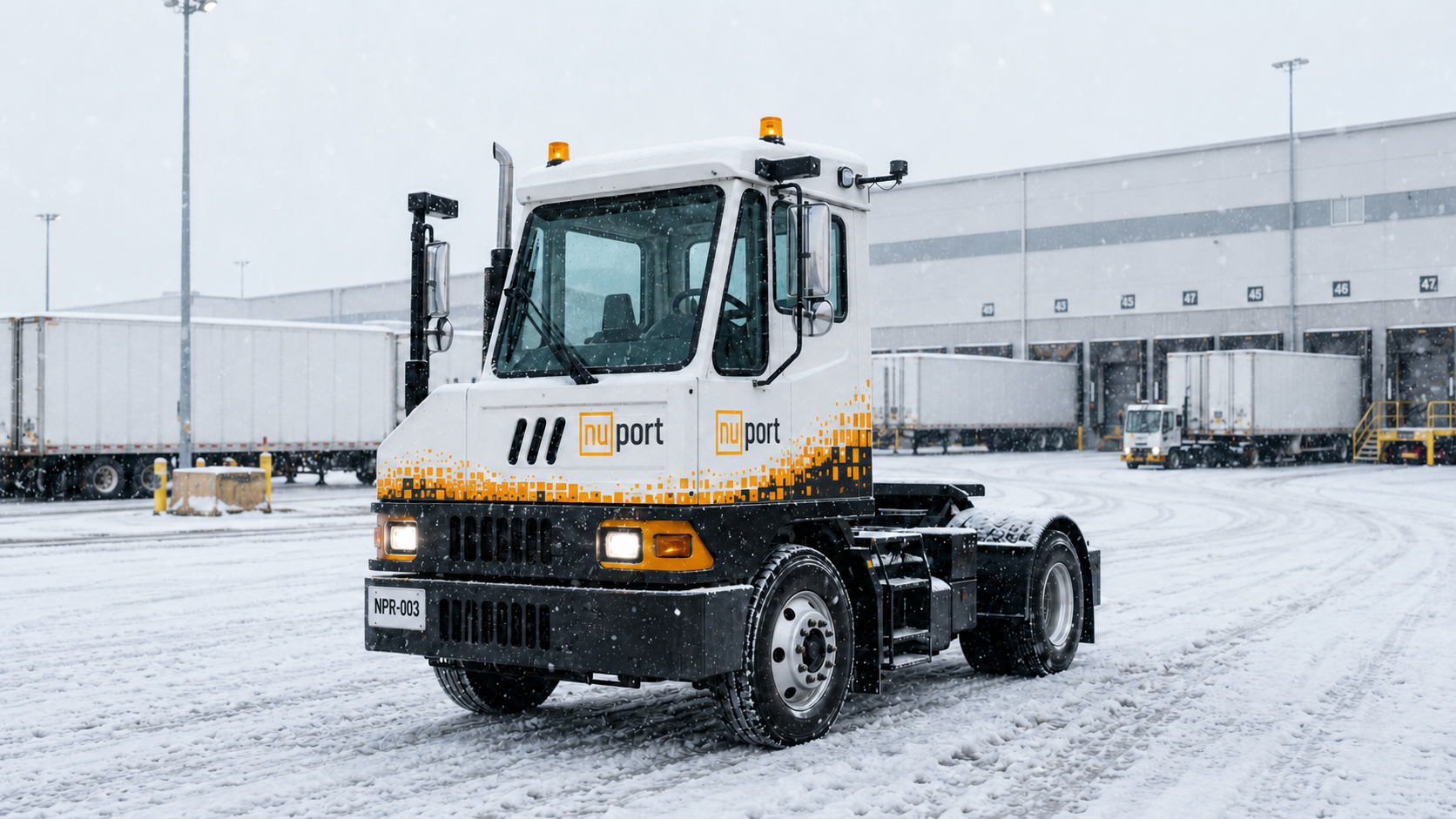
Simulation cannot fully anticipate the glare of a low sun across a terminal apron, a downpour that changes what the sensors can see, ice on a transfer route, or a site whose layout was redrawn last week and never remapped. In industrial logistics, that variability is not an edge case. It is the operating condition.
The strategic consequence is worth stating plainly. Falling build costs benefit every company in this market, including NuPort. Time spent operating in difficult conditions benefits only the companies that have already spent it, and that is the asset a well-funded competitor cannot buy or compress.
We started with the hardest environments first
Many autonomy companies began on wide, well-marked highways, where the geometry was simpler and the demonstrations cleaner. NuPort went the other way and started where the operational pain and the economic case are concentrated: freight terminals, intermodal yards, constrained logistics corridors, mixed-traffic industrial facilities and severe weather environments. That choice shaped the architecture.
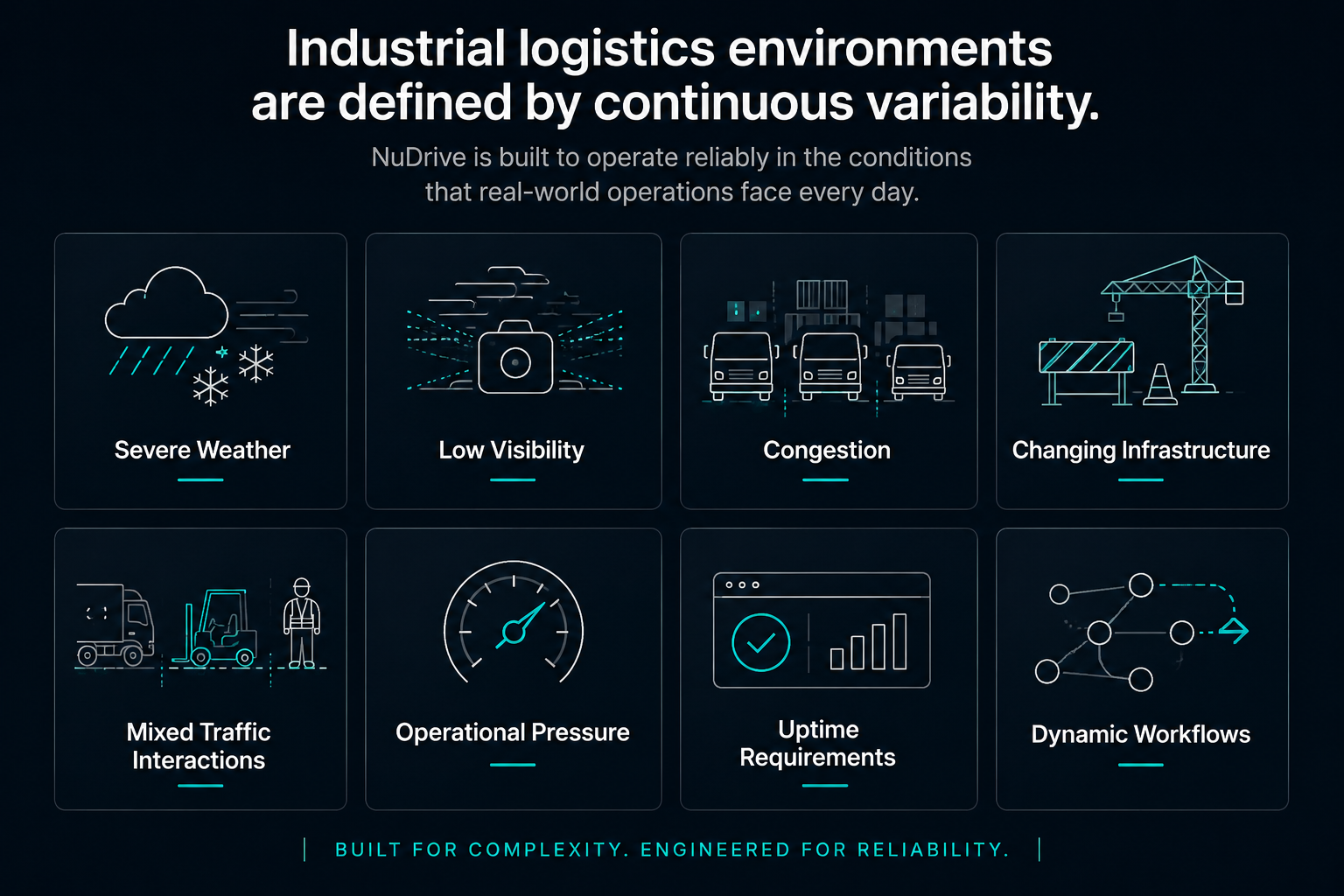
Safety is the first requirement in every one of these environments, and it is a design constraint on the platform rather than a feature layered on top of it.
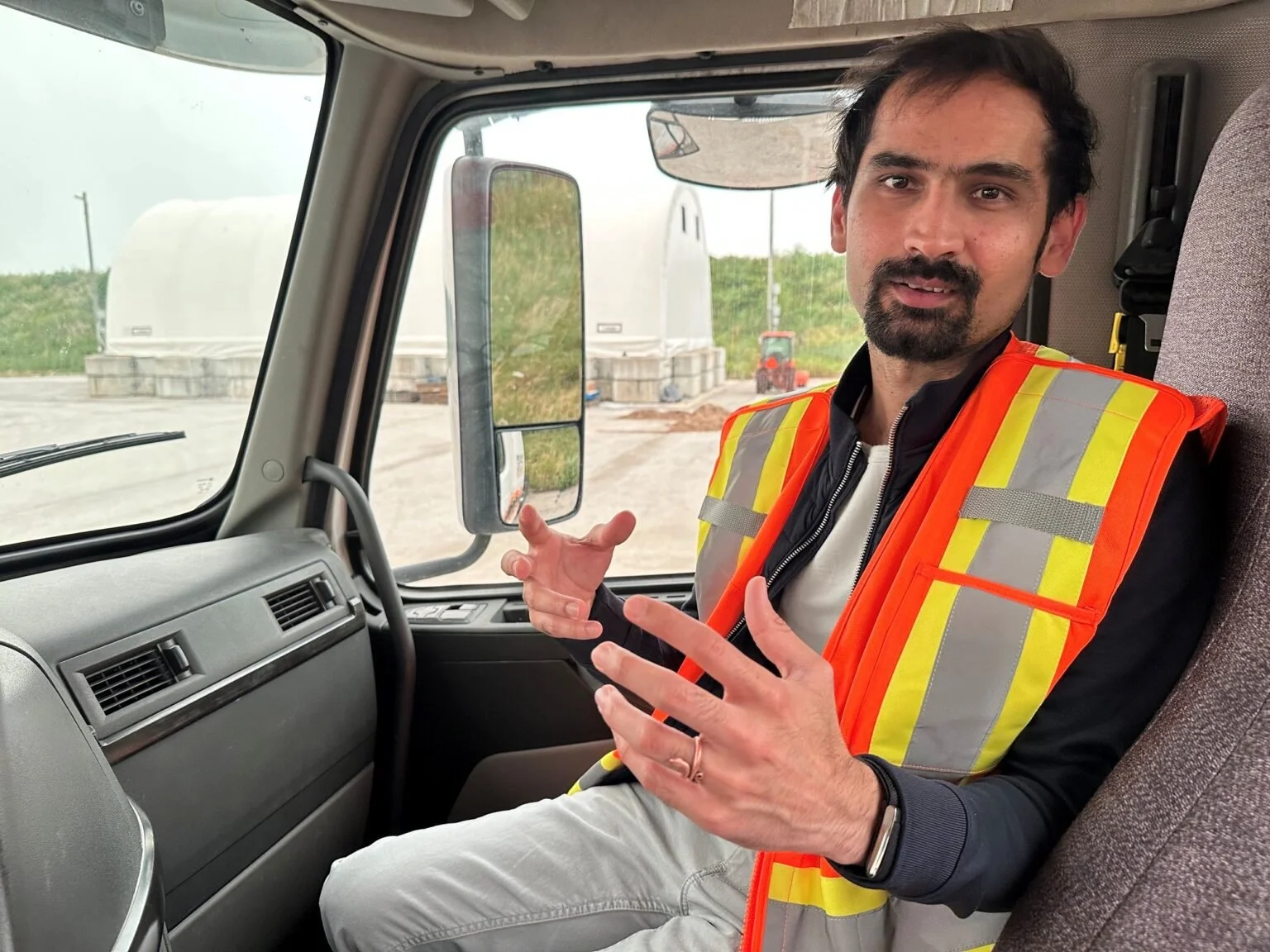
Raghavender Sahdev, Chief Executive Officer, NuPort Robotics
"The measure of an autonomous system is not how it performs on its best day. It is how it handles its worst. If the platform stops working because of a snowstorm, a tight unmapped corner or a burst of yard traffic, it is not an industrial solution. We built NuDrive for the environments where automation is needed most, where conditions are hard and downtime is not an option."
Inside NuDrive
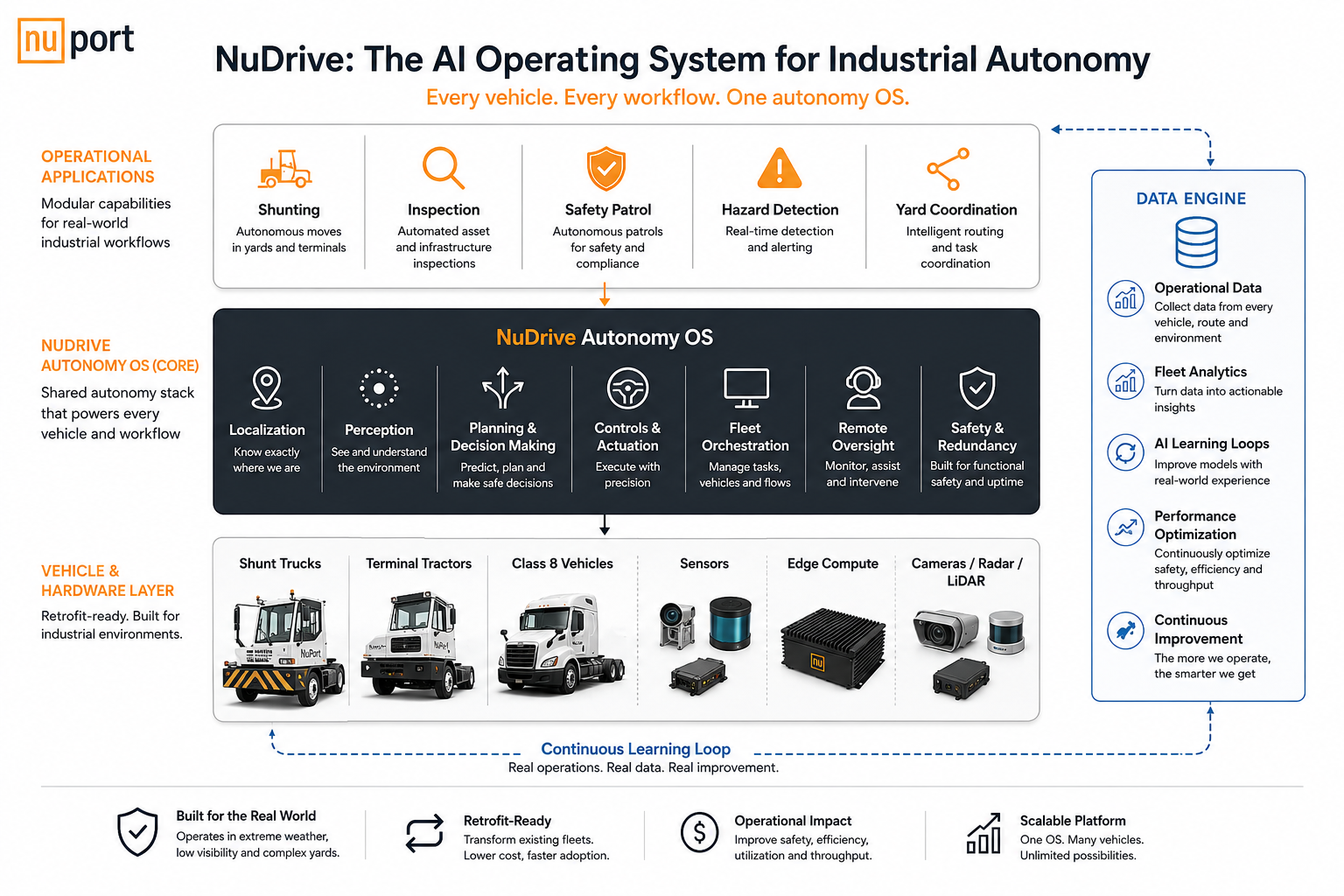
NuDrive is built as a reusable platform with three layers.
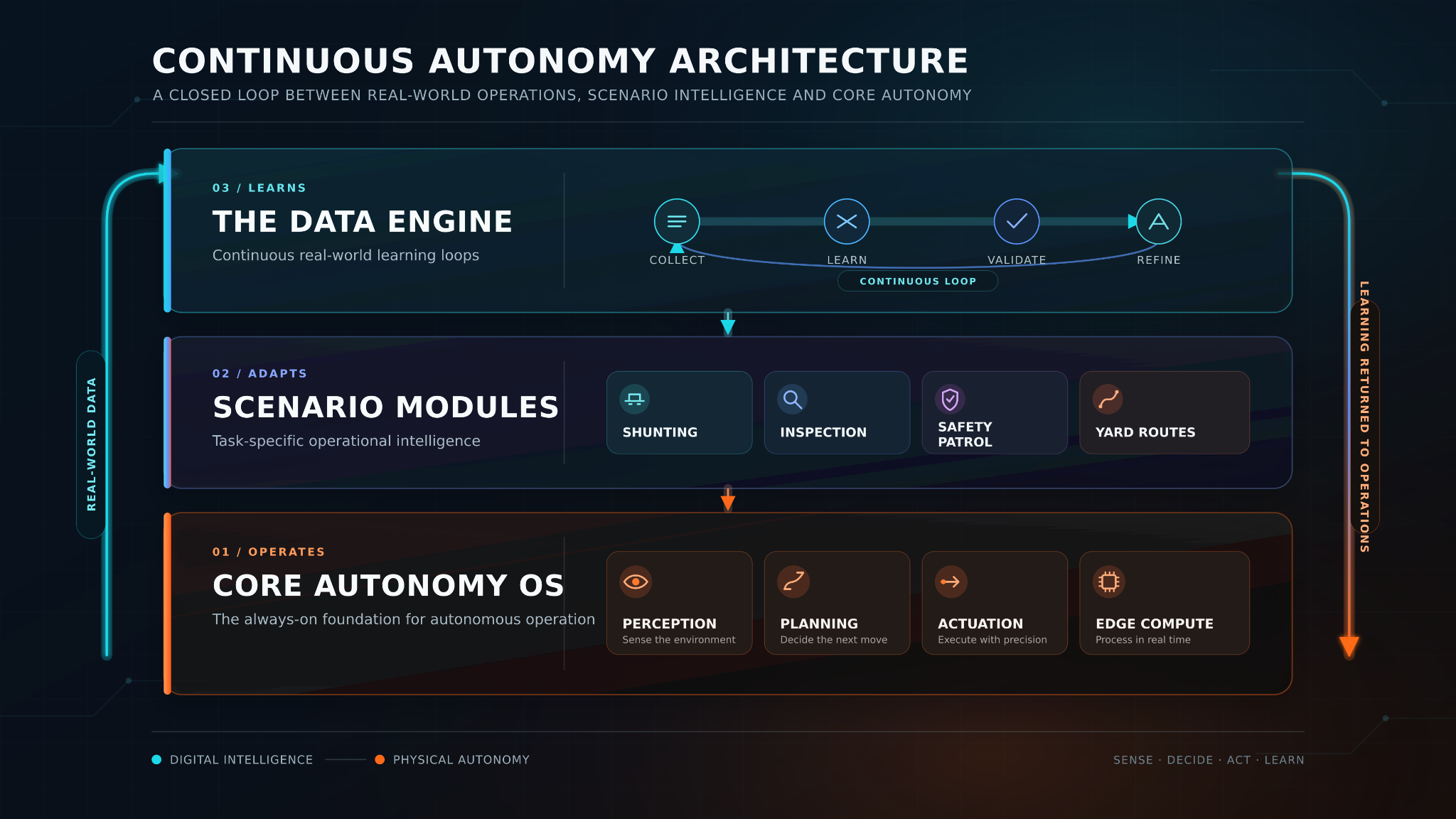
The Core Autonomy OS is the foundation: perception, localization, planning, controls and actuation, edge compute, safety and redundancy architecture, fleet orchestration and remote operations support. It is designed to run across multiple vehicle types and environments, so each new site starts from a working foundation.
Scenario Modules sit on top and handle specific work: autonomous shunting, inspection, safety patrol, hazard detection, terminal transfers. Customers can add capability over time without rebuilding infrastructure, which matters when autonomy has to earn its way into an operation one workflow at a time.
The Data Engine makes the first two compounds. Every route run, every close-quarter interaction managed and every weather event navigated feeds back into the platform, and operational data gathered in real environments becomes strategic infrastructure.
Hardware Agnostic, not replacement
One of the largest barriers to autonomy adoption in industrial fleets is replacement cost.
Very few operators can retire a working fleet of Class 8 trucks or terminal tractors to buy purpose-built autonomous vehicles, and fewer still want to take that risk on a category still proving itself. An autonomy strategy that depends on fleet replacement asks for a capital decision most customers are not positioned to make.
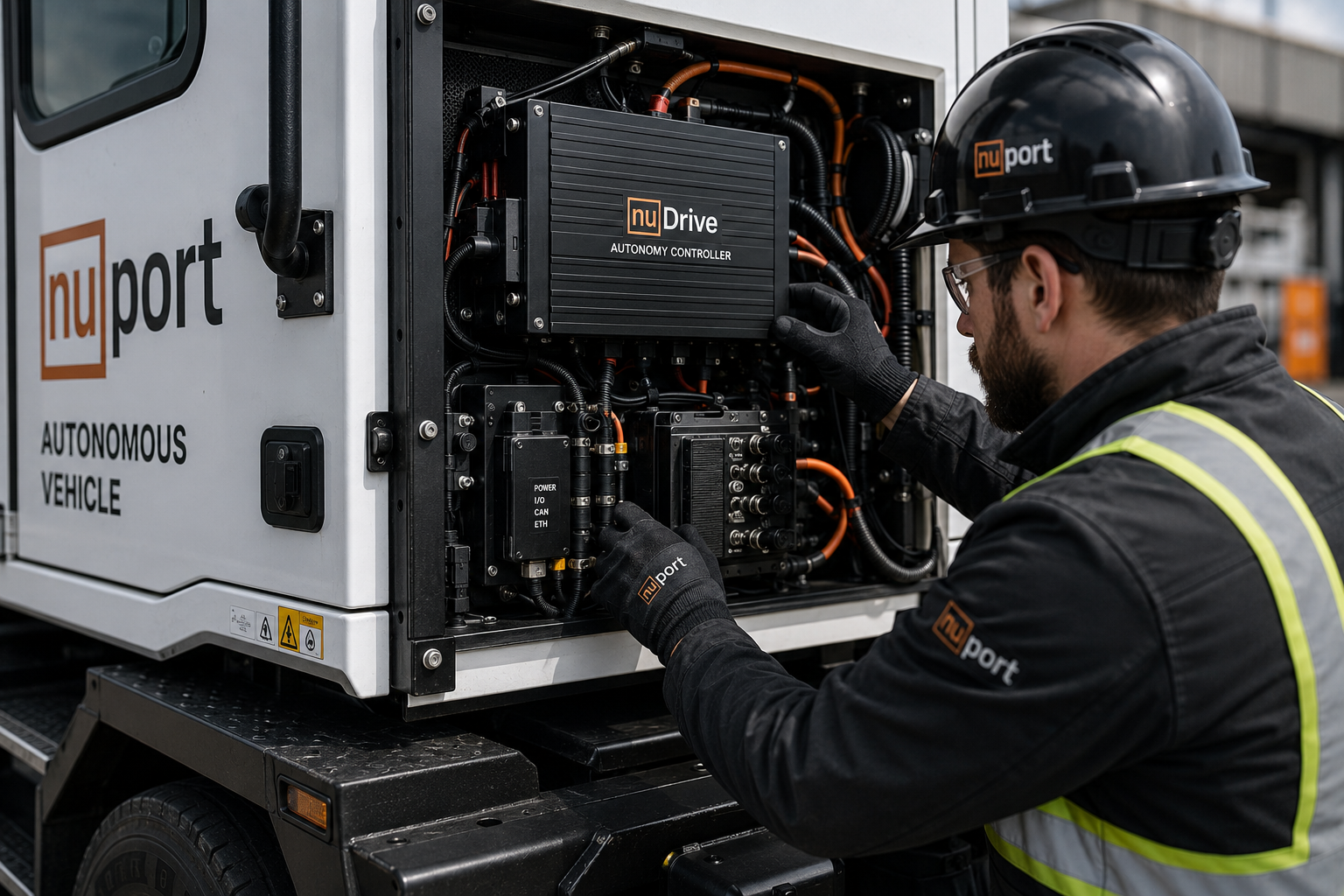
NuDrive was designed around that constraint. The platform is built to retrofit existing commercial vehicles with NuPort's proprietary sensor systems, ruggedized onboard compute, controls and actuation, and remote monitoring, turning assets already on the books into autonomy-enabled infrastructure. For the customer, that makes autonomy an operational upgrade on vehicles already in service, sized and scheduled like any other fleet investment.
The future belongs to deployable systems
The conversation in this industry is moving away from isolated technical milestones and toward the question that decides every deployment: whether the system holds up under pressure.
That shift favours companies that designed for operational reality from the start, which is the standard NuDrive was built against. The leaders in industrial autonomy may not be the companies with the largest research budgets or the most polished demonstrations. They are more likely to be the ones able to deploy autonomy reliably, and safely, where freight actually moves.
Our roadmap follows that logic, expanding from the hardest environments outward rather than the other way around.
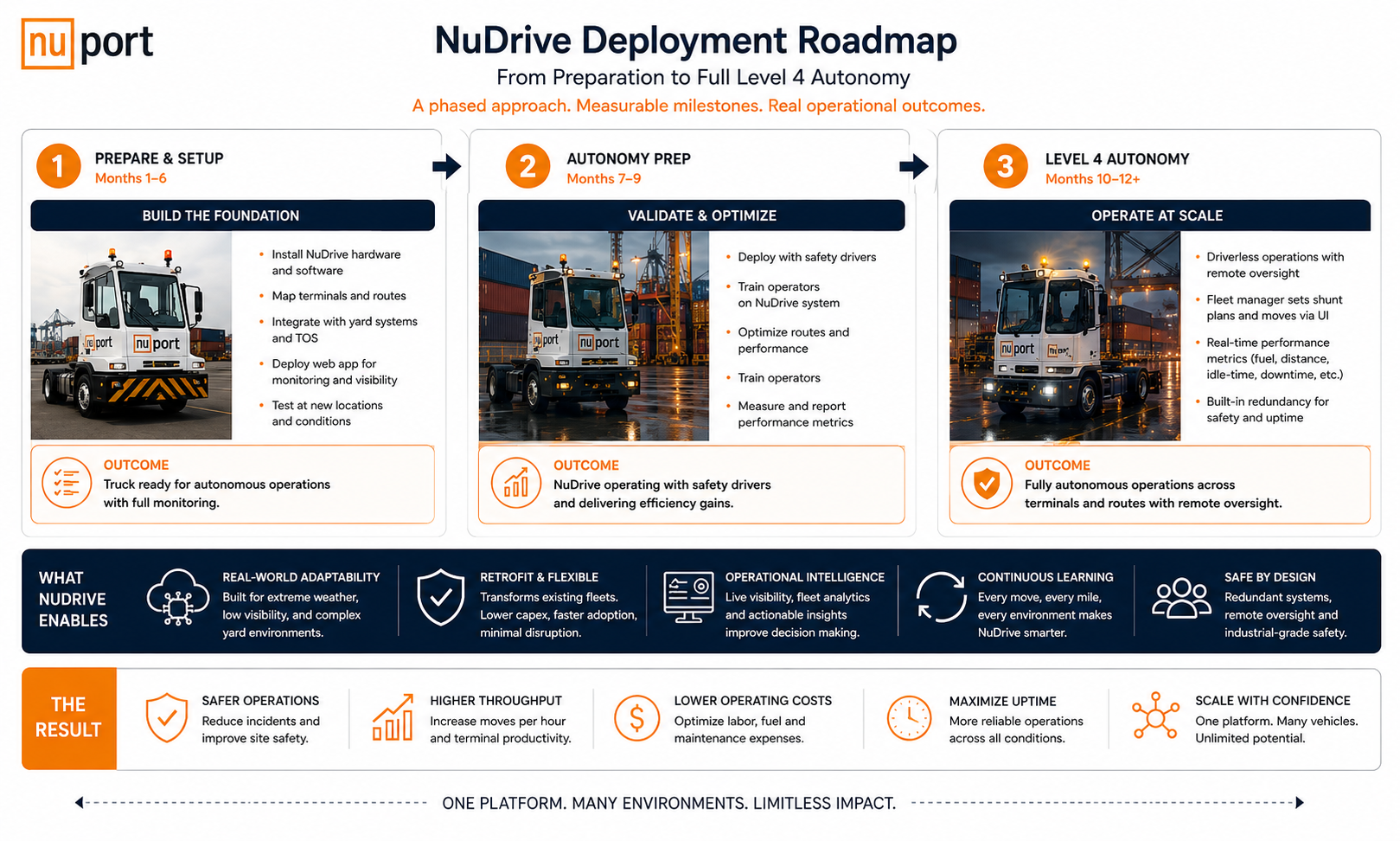
That is the company NuPort is building. Autonomy as operational infrastructure, not autonomy as a demonstration.
NuDrive | The operating system for industrial autonomy.
Built for freight. Built for industrial environments. Built for operational performance.
NuPort Robotics
NuPort Robotics is a Canadian autonomous trucking and Physical AI company building the AI, data and software that bring autonomy into real freight and industrial operations.
To discuss NuDrive for your operation or learn more about NuPort, contact our team.